Guru Gobind Singh ( pronunciation (help·info); Punjabi: ਗੁਰੂ ਗੋਬਿੰਦ ਸਿੰਘ ਸਾਹਿਬ;Hindi: गुरु गोबिंद सिंह साहिब जी ;born Gobind Rai;[1] 22 December 1666 – 7 October 1708[2]) was the tenth of the ten Sikh Gurus, the eleventh guru being the living perpetual Guru, Guru Granth Sahib (the sacred text of Sikhism). He was a warrior, poet and philosopher. He succeeded his father Guru Tegh Bahadur as the leader of Sikhs at the young age of nine. He contributed much to Sikhism; notable was his contribution to the continual formalisation of the faith which the first Guru Guru Nanak had founded, as a religion, in the 15th century.[3][4] Guru Gobind Singh, the last of the living Sikh Gurus, initiated the Sikh Khalsa in 1699,[5] passing the Guruship of the Sikhs to the Eleventh and Eternal Guru of the Sikhs, the Guru Granth Sahib.
Contents
pronunciation (help·info); Punjabi: ਗੁਰੂ ਗੋਬਿੰਦ ਸਿੰਘ ਸਾਹਿਬ;Hindi: गुरु गोबिंद सिंह साहिब जी ;born Gobind Rai;[1] 22 December 1666 – 7 October 1708[2]) was the tenth of the ten Sikh Gurus, the eleventh guru being the living perpetual Guru, Guru Granth Sahib (the sacred text of Sikhism). He was a warrior, poet and philosopher. He succeeded his father Guru Tegh Bahadur as the leader of Sikhs at the young age of nine. He contributed much to Sikhism; notable was his contribution to the continual formalisation of the faith which the first Guru Guru Nanak had founded, as a religion, in the 15th century.[3][4] Guru Gobind Singh, the last of the living Sikh Gurus, initiated the Sikh Khalsa in 1699,[5] passing the Guruship of the Sikhs to the Eleventh and Eternal Guru of the Sikhs, the Guru Granth Sahib.Contents
- 1 Early life
- 2 Leaving of Anandpur Sahib and Return
- 3 Founding of the Khalsa
- 4 Pilgrimage from Anandpur Sahib to Talwandi Sabo
Early life
Gobind Singh was born to Guru Tegh Bahadur, the ninth Sikh guru, and Mata Gujri in Patna. He was born while his father was on a preaching in Assam. As a child, he learnt Persian, Sanskrit, and martial skills become a warrior.[5]
Guru Gobind Singh's birthplace
Gobind Singh married three times[6][7][8] and had four children.[9] He was married off to Mata Jito in 1677, at the age of 11.[10] They had three children together Zorawar Singh, Jujhar Singh and Ajit Singh.[9] He married Mata Sundari in 1684, and the couple had one child, Sahibzada Fateh singh.[9][11] His third wife was Mata Sahib Dewan.[9]
Leaving of Anandpur Sahib and Return
In April 1685, Guru Gobind Singh shifted his residence to Paonta in Sirmaur state at the invitation of Raja Mat Prakash of Sirmaur. According to the gazetteer of the Sirmur State, the Guru was compelled to quit Anandpur Sahib due to differences with Bhim Chand, and went to Toka.[12] From Toka, he was invited to Nahan, the capital of Sirmaur by Mat Prakash. From Nahan, he proceeded to Paonta. Mat Prakash invited the Guru to his kingdom in order to strengthen his position against Raja Fateh Shah of Garhwal. At the request of Raja Mat Prakash, the Guru constructed a fort at Paonta with help of his followers, in a short time. The Guru remained at Paonta for around three years, and composed several texts.
The hostility between Nahan King and Fateh Shah, the Garhwal king continued to increase during the latter's stay at Paonta, ultimately resulting in the Battle of Bhangani near Paonta. Fateh Shah attacked on 18 September 1688; the battle ended with the Guru's victory. In the Battle of Nadaun in 1687, the armies of Alif Khan and his aides were defeated by the allied forces of Bhim Chand, Guru Gobind Singh and other hill Rajas. According to Bichitra Natak and the Bhatt Vahis, Guru Gobind Singh remained at Nadaun, on the banks of the River Beas, for eight days, and visited various important military chiefs. Sometime after the Battle of Bhangani, Rani Champa, the dowager queen of Bilaspur requested the Guru to return to Anandpur Sahib, or Chakk Nanaki, as it was then called, the Guru agreed. He reached Anandpur Sahib in November 1688.
Founding of the Khalsa
 Old Fresco of Guru Gobind Singh Ji and The Panj Piare found in Abandoned Gurdwara Bhai Than Singh built in the reign of Maharaja Ranjit SinghIn 1699, the Guru sent hukmanamas (letters of authority) to his followers, requesting them to congregate at Anandpur on 13 April 1699, the day of Vaisakhi (the annual harvest festival).[13] He addressed the congregation from the entryway of a small tent pitched on a small hill (now called Kesgarh Sahib). He first asked everyone who he was for them? Everyone answered - "You are our Guru." He then asked them who were they, to which everyone replied - "We are your Sikhs." Having reminded them of this relationship, He then said that today the Guru needs something from his Sikhs. Everyone said, "Hukum Karo, Sache Patshah" (Order us, True Lord). Then drawing his sword he asked for a volunteer who was willing to sacrifice his head. No one answered his first call, nor the second call, but on the third invitation, Daya Ram (later known as Bhai Daya Singh) came forward and offered his head to the Guru. Guru Gobind Rai took the volunteer inside the tent. The Guru returned to the crowd with blood dripping from his sword. He then demanded another head. One more volunteer came forward, and entered the tent with him. The Guru again emerged with blood on his sword. This happened three more times. Then the five volunteers came out of the tent in new clothing unharmed.
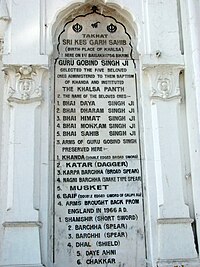
An inscription naming the five members of the Khalsa Panth, at Takht Keshgarh Sahib, the birthplace of Khalsa on Baisakh 1, 1756 Vikram Samvat.


No comments:
Post a Comment